Get Paid To Promote, Get Paid To Popup, Get Paid Display Banner -->
Showing posts with label architecture. Show all posts

Monday, February 14, 2011

Down the Rabbit Hole

Photobucket

One of my favourite things that I do at the Architects' Journal is manage and edit the Small Projects Awards and issues. Typically, in our mag, we push plush new office buildings or grand University schemes. If we do feature new houses or smaller projects, they tend to be by big-name architects on equally lavish budgets.

But the Small Projects Awards is a chance for smaller practices to show off what they can do on more modest budgets (�250k or less). Sure, we get sent hundreds of house extensions, but for every twenty bread and butter backyard extensions, we receive one incredible tree house or a stunning self-build hideaway in the hills. 

Given that we get sent upwards of 200 entries for a shortlist of only 24 projects, there's always one or two projects I've got a soft spot for that don't make the cut. One of my favourite projects this year that just didn't make it was Neil Boyd's 'Down the Rabbit Hole'. 

Neil submitted this project as part of his final masters exhibition at Strathclyde University and I wanted to give it some love because - contrary to most of the client-driven projects we received - Neil's was one of the few projects where an individual saw an opportunity to create a little something and then just got on with making it. The rabbit hole took two weeks to build using reclaimed OSB and timber left over from the end of year diploma exhibition. As expected, health and safety issues soon got in the way of fun and the structure had to be removed after only one month.

I love that it's imaginative and a little bit silly - a project that transformed an ugly corridor into a mysterious and whimsical escape from the Uni's architecture department. His visuals perfectly reflect the project: they're deceptively simple, captivating and just a little bit magical.


Photobucket

Photobucket

Photobucket

Photobucket

Photobucket

Photobucket

Photobucket

Photobucket

Photobucket

Friday, October 29, 2010

Derrida, deconstruction, and discontent

Photobucket

Sometimes literary theory just really pisses me off. I love pure philosophy and cultural theory is often intriguing, but the thought of applying Marxism or feminism or some other "ism" to historical events or literary texts (as so often the fashion in academic circles these days) makes me want to slit my wrists. Sure, I can see why it might be interesting to look at the Oedipus myth in conjunction with Freud's oeuvre, but a Freudian reading of Aeschylus (to take but one example) completely baffles.

I've been trying to read Derrida's Limited Inc, but it's slow going. Partly because I feel I need a few uninterrupted hours to blitz through the essays in one go, but also because I feel my brain boiling over with, not quite rage, but certainly annoyance.  Admittedly, it's not entirely Jacky D's fault for I find Speech Act Theory on the whole completely ludicrous. How much more ridiculous, then, am I bound to find a deconstructive (destructive?) reaction to an underwhelming theory.  Having said that, I feel I ought to finish reading the thing and do quite a lot of thinking before I go mad-dog rabid. After these messages...

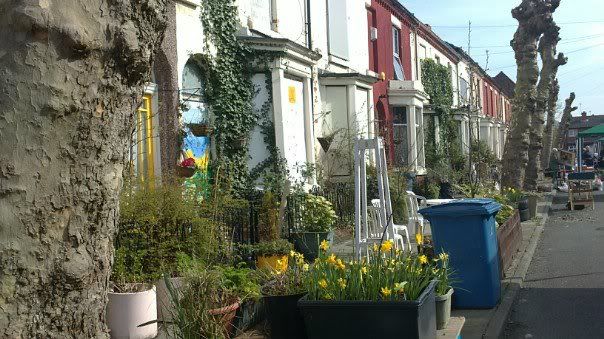
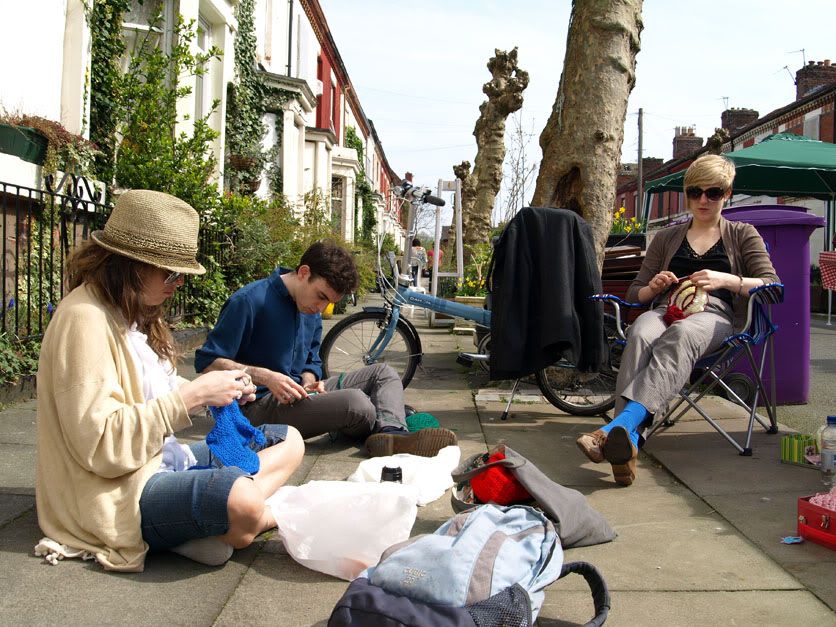
A far more instructive and stimulating experience was to be found at last night's Rip it Up lecture, part of a series at London Met organised by my old boss and now Evening Standard architecture critic, Kieran Long.  Paul Domela, the programme director of the Liverpool Biennial, gave the lecture, which focused on the role of public art in urban regeneration and community development in Liverpool and beyond.  I've never actually been to Liverpool so I found the talk interesting, not only for what Paul had to say about public art, but also for what he had to say about the nature and history of the city itself.

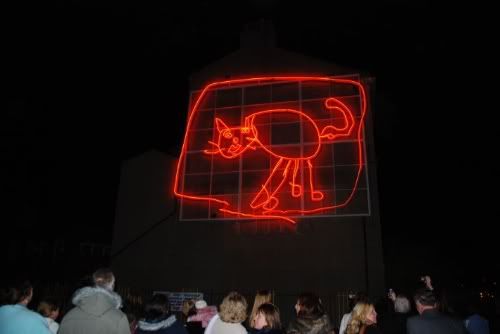
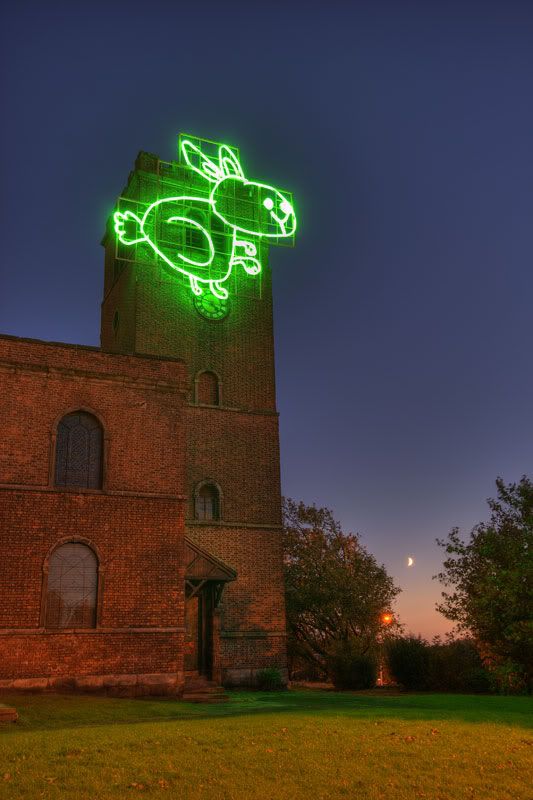
It's difficult to get a good grasp of the situation simply from one brief lecture but I was completely taken aback by photographs of residential streets with every single house boarded up, and big department stores in the city centre left empty and abandoned.  Paul talked us through a variety of projects - from the Carins Street market started by local residents to Ron Haselden's wonderful work creating neon lights out of local schoolchildren's drawings - all of which are grounded in ideas of community engagement and the beautification of depressed and dilapidated areas.
Photobucket

Photobucket

As an artist, a curator, and a critic, I find these projects inspiring and exciting but in the Q and A, Professor Robert Mull, head of the faculty of Architecture at London Met, asked a provocative question that really got me thinking.  His question to Paul was that, given the history of civil disturbance in the city (particularly the Toxteth riots), wasn't it possible to offer a reading of these pleasant, feel-good community arts projects as a kind of social and cultural lobotomy: art in place of political action.  I don't entirely agree with his assessment, given that the nature, even definition, of community is so ephemeral and changeable.  I'm also rather committed to the idea of art as a force for good, for positive social change.  But I'd never really thought about art as a substitute for active political action, as if projects that bettered urban areas were a kind of passive non-interaction when contrasted with more direct and active participation of strikes, riots, or protests.  Typically, when I'm inclined to make such juxtapositions it's in a Chomsky-esque fashion: sport or television as a substitute for direct political engagement.  But I suppose that's what makes a great talk so important - it forces you to check your prejudices and assumptions, to reassess previously held beliefs. 
Photobucket

If you have any interest in architecture or urbanism or just in thinking a little bit differently about the cities we live in, do make an effort to attend. Next week's lecture is about Belfast and promises to be just as engrossing, engaging, and essential.

The series continues until 13 January, every Thursday at 6.30pm.

London Metropolitan University School of Architecture and Spatial Design
Spring House
40-44 Holloway Road
London N7 8JL

Monday, October 25, 2010

visual inspiration: griffith observatory

Photobucket

photos by: Floyd B. Bariscale, seany, Goodnight London, and prayitno

While Los Angeles certainly doesn�t hit my city sweet spot, it does have its own peculiar charm.  It�s one of the most superficial cities I�ve ever lived in, yet it has a colourful and interesting history of cultural philanthropy.  LA�s museums might not be as plentiful or as show stopping as her New York City counterparts, and yet, for all the sky-scraping towers in Manhattan, there�s no place quite so wonderful for star gazing as LA�s Griffith Observatory.

Photobucket

As a child, I found everything about the Observatory completely spellbinding: the long, winding drive up the hill; the art-deco curve of the central rotunda; the Foucault�s pendulum swinging underneath; Hugo Ballin�s wall murals depicting the history of astronomy; and especially, the view over the city at night. 

Photobucket

Photobucket

Photobucket

Photobucket

But I think the thing that captivated me then, as now, was the set apartness of the place; the feeling that when you finally arrived at the top of the hill you weren't in LA anymore.  That once you passed through the Observatory's doors you weren't just entering a building, but another world.  As a child, you never felt that this alchemy resulted from the technical capabilities of the telescopes or the transporting trickery of the planetarium, but that the place itself was somehow closer to the Milky Way. Who cared about the celebrities on Sunset Boulevard when the glitter at Griffith was so much more spectacular.  And despite the fact that I�ve visited rather a lot of beautiful buildings since my first trip, this sense of mystery and otherness has remained. I find the Observatory just as beautiful now as I did then.

Photobucket

Photobucket

Monday, August 2, 2010

the filling station

Photobucket


Been wanting to flag this up for a while. Can't believe it was a month ago! Tempus fugit and all that...

Along with my amiga, Nicola Read of 815 Agency, we put on a smashing party (if I do say so myself) to close out this year's London Festival of Architecture.  I'd had my eye on the vacant petrol station for well over a year - I live around the corner and pass by nearly once a day - and it took the better part of a few months of solidly pestering the developers before they agreed to let us use the site.

Once we had the site, we had to figure what to do with it.  After doing some research into the history of Clerkenwell, we settled on the idea of a large feast with food sourced from local restaurants.  After that, it was just a matter of getting everyone on board - thankfully Clerkenwell's restaurants are awesome and everyone was happy to chip in. A huge, huge thanks to Caravan, The Modern Pantry, St John, Hix Oyster and Chop House, Bea's of Bloomsbury, The Ginger Pig, Bompas and Parr, and Chapel Down Wines for their generosity and assistance with the event. Also, an enormous thank you to all of our friends who chipped in (or were dragged, rather) and helped out. Seriously, we couldn't have done it without you.

I'm really pleased with how the whole event turned out, but especially with the table we built - a 10-metre long monster, constructed from 300+ polystyrene boxes (generously sponsored by the British Plastics Federation) - 'twas a thing of beauty.

Though I didn't see it for myself, as I was running around like a frazzled bride on her wedding day, a friend later told me that people were stopping their cars on Clerkenwell Road to take pictures.  I don't know about you, but for me, that constitutes a result indeed.

We're already plotting our next event, to be bigger and better, of course.  It's all going to kick off in January 2011. Stay tuned, kids.

Full set of images here.

Photobucket

Photobucket

Photobucket

Photobucket

Photobucket

Photobucket

Photobucket

Photobucket

Tuesday, May 18, 2010

Niyang River Visitor Centre

Photobucket

love this. 

on the banks of the Niyang River in Tibet.

by Standardarchitecture-Zhaoyang Studio.

all photos by Chen Su.

Photobucket

Photobucket

Photobucket

Wednesday, April 7, 2010

seed cathedral

I know this has been everywhere: in all the papers and on all the blogs, but I just think it's so incredible that I want to put it here too, especially for my USA friends who probably haven't seen it yet.

For those (few) who don't know, it's Thomas Heatherwick's UK pavilion for the World Expo, opening in Shanghai next month. I would happily replace my teeth with a set of whale-bone dentures to go to the Expo, but I'm still working it out. I've got a post card of the original visualisation on my desk and it makes me happy every time I look at it. The same way that I wonder in amazement at how in the hell the Romans managed to build the Colosseum (yeah, I know, lots of slaves...still, it's pretty damn impressive), I'm surprised and pleased that someone had the audacity to build such a ridiculous, new-fangled contraption. It looks amazing on the outside, amazing on the inside, and I'm betting the photographs and the video footage just doesn't do it justice.

I, for one, cannot wait to see the thing up close. Fingers crossed.

Photobucket

Photobucket

Photobucket

Photobucket

Photobucket

Photobucket

Photobucket
(all photos from UKTI)

Friday, March 19, 2010

Senate House

Photobucket

So, last Sunday I was writing up my LFW piece for the AR.  Lots of talking about how LFW is finally coming round to exploiting the architecture of London for show venues. This season alone saw the Royal Courts of Justice, Freemasons' Hall, and the Parade Ground at Chelsea College of Art serve as the backdrop for a host of gorgeous dresses. One of the more interesting venues this season was Senate House. Interesting to me anyway as I'm absolutely crazy about Senate House. I think it's a love it or hate it sort of building, but for me it's love all the way. Rather surprising, as Senate House is where I spend an awful lot of time doing research for my PhD, but I'm strangely loyal like that. In an otherwise homogenous part of London, it's gloriously unique. If you haven't been inside, you should go and check it out - the interior spaces are stunning as well. Anyone can access the building and I love that you can walk through it at ground level - there's a beautiful open internal courtyard the connects the North and South Wings - you can walk through from Malet Street to Russell Square Gardens easy like.

Photobucket

Writing my piece, I did a quick Wiki check for construction dates and came across a wonderful quote from the seriously forward thinking Vice-Chancellor, William Beveridge, who pushed for the construction of a new building for the University of London. He raised some dosh from the Rockefeller Foundation and bought back the land that was previously bought and then resold by the government from the Duke of Bedford. Sounds messy. 

Anyway, Beveridge had his money and a site to build on, but whoa, did the man have a mission. He saw the University of London as one of global importance, a serious contender to Oxbridge and thought that the UoL should have a new building, one which stated the University's importance through architecture:
"the central symbol of the University on the Bloomsbury site can not fittingly look like an imitation of any other University, it must not be a replica from the Middle Ages. It should be something that could not have been built by any earlier generation than this, and can only be at home in London ... (the building) means a chance to enrich London - to give London at its heart not just more streets and shops ... but a great architectural feature ... an academic island in swirling tides of traffic, a world of learning in a world of affairs."
I'm so impressed by this, especially in light of Rick Trainor at KCL going out of his way to purchase a wing of Somerset House (which I also love, don't get me wrong), instead of having the vision to do something different, say, not fire a whole host of academics. But that's something else altogether and I've already ranted enough about Trainor and Co. 

I guess it's just that it's increasingly rare to hear anyone make this kind of statement about the role of architecture in a community. The opportunity for a building to enrich its city and its community instead of the ego of the architect. Why are things like Renzo Piano's atrocious Central St Giles being built in the middle of town without so much as a fuss? Do the architects really think these buildings are at home in or enriching London? And I love Beveridge's ambition - he wanted to create a symbol firmly rooted in its time and place - something so of its generation and its city that it would forever symbolise the academic mission of those who created it. What will people say about the London that built Central St Giles and the Strata tower? That we valued electric razors and games of Connect 4? For all the pomp and circumstance of Senate House, it nevertheless remains 'an academic island in swirling tides of traffic', seventy years later. A pretty impressive feat.

Wednesday, September 2, 2009

10 Hills Place

Whoa. It's been nearly a month since my last post. Just goes to show how consumed I've been over the course of the last month. There has simply been no space in my head for anything else other than SALON (LONDON) - I sort of dried up. But thankfully, now that the gallery and events are underway and going well, my wirey, firey little brain has resumed normal service. I have things to say again. Phew! What a relief. So here's a triple threat of posts to make up for having abandoned posting for the last month.

As I was rushing out of the office today, I happened to glance at some proofs on my editor's desk. The building on next week's cover is AMAZING! I mean it's seriously great. One of the most exciting things I've seen in London in ages and it's dead central, but still sort of hidden. Just off Oxford Street, quite close to Oxford Circus tube is a little alley of a street called Hills Place, and at number 10, Amanda Levete Architects have created this little stunner. I think it looks like the side of a silvery shark - the ripples are like gills in the skin. I swung by this afternoon to take a few of my own pics. It's a bastard to get a great shot of, but I wanted to show it off anyway.


Sunday, August 2, 2009

windmills and pavilions


In the chaotic mess that is my life just now, I still manage to take time out to see cool stuff. It keeps me inspired, makes me happy and recharges my mental batteries.

I went to check out the Dalston Mill, a temporary windmill constructed by architects, EXYZT for the Barbican's Radical Nature exhibition on now. This is my kind of architecture. It's temporary, yet more concerned with adding value to its community than most permanent structures. The windmill powers a grinding machine and a battery operated lighting system.

When I rocked up this afternoon, there were about 20 people lined up at the bar, happily frosting cakes as part of a cake-decorating course. The bread ovens were fired up, people were sitting in deck chairs admiring the wheat field, and the little stage had been taken over for a swap shop. Did she just say wheat field? Indeed I did. The wheat field is a sort of reimagining of Agnes Denes' 1982 'Wheatfield - A Confrontation' where she planted and harvested two acres of wheat in Battery Parl landfill in downtown New York. The Dalston Mill wheat field is by no means as spectacular as the Batter Park field, but it's a lovely idea and a nice parallel.

Lately it feels as if London's had an injection in its public life with events, festivals, and pop ups galore. It's difficult to know whether this DIY explosion is an effect of the recession or whether we've just finally come round to the joys and the dynamism of a new kind of cultural life, but long may it continue.

I'm a little loathe to divulge this next detail, for fear of letting a best-kept secret out of the bag, but it's too fantastic not to share. There's a tiny little pavilion next to the big lake in Victoria Park that does one of the nicest breakfasts in London. A friend raved me about the
Pavilion Cafe and, though I'd been meaning to get round to dropping in for ages, today marked my fist visit. A brief moment of panic at walking in to the faintly campsite looking pavilion soon dissappeared when, sat on a bench overlooking the lake, a veggie breakfast was parked in front of me. It's like any other veggie breakfast you've ever had only much, much better - it has smashed avocado! Sigh x 10. If you love breakfast, you must go to this place. Only please take me with you.